This is an open letter to the ITV management who have promoted their programme “Tonight: Harassment Uncovered” which, in places, confuses photography with sexual harassment. The programme aired at 7.30pm on the 23rd of February 2017
Dear ITV
Professional photographers are against any and all harassment of people going about their private and lawful business. To suggest or imply anything else would be disingenuous at best and libellous at worst. Street photography is a legitimate and entirely honourable form of documentary photography practised the world over.
Should any individual use this or any other art form as a cloak to hide their illegal activities then that is an issue that should be part of a Police investigation and not an excuse to demonise an entire genre of documentary photography and film-making.
The laws already exist to stop harassment and stalking and a blanket ban on any and all photography or filming without permission (amateur or professional, it matters not) would be to the detriment of society as a whole.
The BPPA
And Then The Prime Minister Hit Me – the new book from Brian Harris.
Veteran Fleet Street photographer and founder member of The BPPA Brian Harris has just published his long-awaited book “…and then the Prime Minister hit me”. You can follow the story of how the book came into being on Brian’s blog.
When Brian Harris decided as a boy to give up his dream of being a newspaper cartoonist and instead become a photographer, it was a decision that would take him from 1960s Essex to the heart of the British newspaper industry in London and to dozens of countries in search of the images that encapsulate the decades from the 1970s to the present day. Some 200 of these photographs are featured in …and then the Prime Minister hit me… Presidents and royalty, ministers and movie stars, ordinary people caught up in extraordinary events; Brian Harris has captured many of the most famous and compelling people of our time. His honest, often hard-hitting text tells the story behind his pictures, and in so doing, the story of his life.
Drawn from his archive of thousands of prints, negatives and contact sheets, these images document not only Brian Harris’s 45 years as a photojournalist, but also many of the defining moments of modern history. As a staff photographer on The Times, his assignments included Northern Ireland’s ‘Troubles’, the bloody birth of Zimbabwe, the aftermath of war in the Falklands, famine and human suffering in Ethiopia and Sudan. He joined the founding team of The Independent in 1986, with a brief to produce the kind of purposeful editorial photography with which the newspaper became synonymous. His twelve years on the Indy coincided with the start of the civil war in Yugoslavia, the Tiananmen Square massacre, the fall of the Berlin Wall, Czechoslovakia’s ‘Velvet Revolution’ and Saddam Hussein’s invasion of Kuwait.
Aside from such headline-grabbing events, the daily grind of politics has given Brian Harris some of his most memorable images. Caught here on campaign trails, at party conferences and glad-handing the public are presidential candidates, British prime ministers and party leaders – including the unforgettable moment when Labour’s Neil Kinnock took an unplanned dip at Brighton beach.
The personal stories that illuminate Brian Harris’s photographs are a valuable social document of the changing face of the British newspaper industry experienced from the inside. From the heavily unionised working practices of the 1970s, through the post-Wapping fallout that gave birth to The Independent, to life as a freelancer, Brian has seen it all. …and then the Prime Minister hit me… is in part a tribute to ‘Fleet Street’s finest’, who taught the young photographer the tricks of the trade. But this book is dedicated to Brian’s father who built him a darkroom and his mother who made his first flyer for his fledgling photography business back in Romford. Without them, there would be no story to tell.
If you want to know more, please visit Impress Publishing’s website
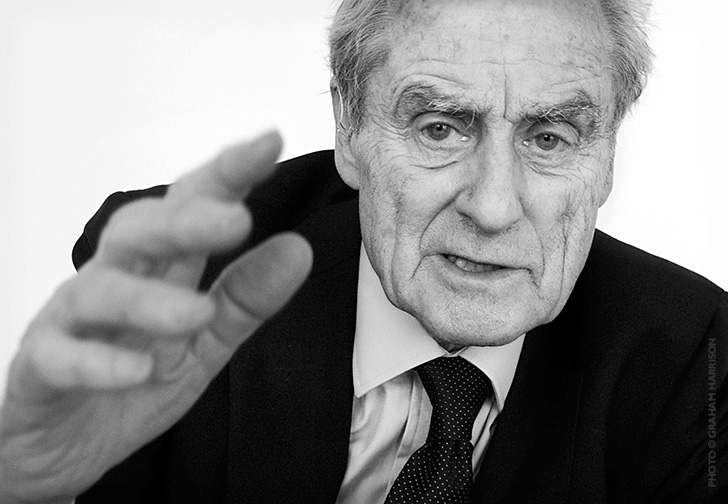
Sir Harold Evans – interview
The book Pictures on a Page by Sir Harold Evans is widely considered the definitive text on photojournalism, layout and picture editing.
Voted the all-time greatest British newspaper editor by British journalists in 2001, Evans made his name at the Northern Echo and at the Sunday Times, which he was editing when he wrote Pictures on a Page in 1978. What is less well known among photographers is that Pictures on a Page was just one in a series of five text books he wrote for working photographers, journalists and students. “Everything we knew… we knew it because of Harry,” said Guardian editor, Alan Rusbridger, in 2013.
When Graham Harrison, a member of The BPPA, met the 87-year old at the Media Space in May he found his interest in photography was as great as ever.
As is his recognition of the dangers that photographers encounter. In his forward to Five Thousand Days, published by the BPPA in 2004, Evans wrote that press photographers “cannot move in the shadows, as can the reporter. These digital days, getting a picture back to the newspaper is not the nightmare it used to be, while the risks in taking a picture at all have multiplied”.
A feature documentary about Evans’ investigative journalism, ’Attacking the Devil: Harold Evans and the last Nazi War Crime’, directed by Jaqui and David Morris makers of McCullin (2012), premieres in January.
You can read Graham Harrison’s article on Photo Histories.
Election 2015 – Never Mind The Deja Vu
Back in 2005 The BPPA put together a project called “Never Mind The Ballots” which was a response to the “most stage managed, spin driven and least visually interesting elections in modern times”. Press photographers faced a month of ten minute photocalls and long frustrating waits whilst trying to find interesting and journalistically significant images. Ten years later the sense of deja vu was only diluted by the fact that things had actually become worse.
Because of that, we decided to run Election 2015 – a partner to the 2005 project to show that the ingenuity and skill of press photographers haven’t faded. The gallery is now on line HERE and if you like it please share it, tweet it and make sure that as many people as possible see what lengths we have to go to to get the pictures that actually tell the story.
Our Draft Code
Immediately after the Leveson Inquiry we started to think about how a code of conduct could be drafted for The BPPA that would help prospective members and the British public understand what our profession is all about.
We looked at similar documents from all over the world and we looked at the various codes of conduct and practice that our clients have already signed up to. It has been a massive task and we are proud to unveil what we are calling the “Final Draft” which was approved at a Board meeting last week. Here is the code in full:
The British Press Photographers’ Association Code of Conduct
Members of The British Press Photographers’ Association are professional photographers concerned with taking, editing and distributing news, feature, sports and other editorial photographs. Their work is predominantly for the British news media. The photographers take every care with their work, but it remains the responsibility of publishers to carry out checks concerning accuracy, damage to reputation, and the will of the Courts.
Press photographers should:
- Observe the highest ethical, technical and creative standards. They should conduct themselves in a manner reflecting those standards and be aware that their actions, both positive and negative, reflect on the profession as a whole
- Not materially alter their images, or edit them in such a way as to give misleading impressions of news events
- Provide accurate and comprehensive caption information
- Resist any offers of payment or other inducements from third parties involved in the story to change the way they approach the coverage of news events
- Remember they are subject to the laws of any country they work in
- Always be aware of the codes of conduct observed by their employers and clients and act appropriately when working on their behalf
- Treat people they meet in the course of their work with respect and dignity, giving special consideration to anyone suffering the results of war, crime or other difficulty or hardship
- Protect their own intellectual property and respect the property of others
- Defend media freedom, and the right to work in a fair and unfettered manner
- Feel able to refuse any work involving excessive or unnecessary risks to themselves or others
Ten clauses that sum up how we should behave rather than a set of absolute rules. This is important because we live in an age where there are lots of blurred lines and where each of us may well be doing a wide range of work for which each of these clauses will have greater or lesser significance. PR and hard news are very different and it is important that you read the Code with that in mind.
You will probably have questions about the wording and why it does and doesn’t feature X or Y and we are more than happy to answer those questions. We anticipate the most common query being about why it doesn’t have more specific rules and the answer there is in clause 6:
“Always be aware of the codes of conduct observed by their employers and clients and act appropriately when working on their behalf”
This is important because it refers to the IPSO Editor’s Code for those working for newspapers and other codes for magazines, broadcasting both in the UK and around the world.
According to our constitution this code can come fully into force once it has to be approved at a General Meeting and the next one is scheduled for the 4th of June in London.
New from the UKPCA – Passport and Chips
All change at the UKPCA – the UK Press Card Authority, where the BPPA is one of the card issuing gatekeepers. At today’s meeting they voted nemo contra for two fundamental reforms.
The meeting faced two problems. First, Custom Card, who administer the card on behalf of the gatekeepers, had detected two duplicate applications for the card from one individual through two different gatekeepers using subtly different details! The database relies on these details and the fraudulent application was only spotted because both applications came in on the same day with the same photograph. Fraudulent information undermines the integrity and security of the entire system. Clearly the case for independent verification of personal information is overwhelming.
Secondly the UKPCA had been approached by Downing Street police, asking in the nicest possible way what we could do about security generally, and saying they got on well with the regular photographers, but they’d had complaints from them about people getting in with Demotix cards, some of whom did not appear to be even taking any pictures!
Demotix cards – the ones that look surprisingly, alarmingly, you might even suspect deliberately, just like ours.
Custom Cards wanted to activate the card chips, which all UKPCA cards now carry, in full – all data, not just pin numbers (the phone line verification for which is not 24 hours). And they now have an app which would allow police to check card holders instantly and speedily. That would take care of any confusion over those Demotix cards looking so much like ours, because they just don’t have one. And avoid what one photographer recently went through in Downing Street – 45 minutes while police checked him out.
So why on earth hasn’t this been done before? The chips are all there, all ready, we all pay for them….answer, because the NPA and NS simply refused to cooperate. That’s now history. The vote’s been taken. All gatekeepers must now accept fully working chips as a condition of remaining gatekeepers. Custom Card will now switch them on, and distribute the app.
Back to personal information – the other major change. From today, for verification purposes, all applications for the press card must be supported with the number, and a scan, of either passport or driving licence. Speaking for myself, I cannot imagine why anyone thinks this such a big deal – every year I submit both my passport and driving licence numbers three times, to get into the major party conferences. And have always thought it absurd that I have to meet a higher standard of security vetting to get into those than I do to stand all day outside No.10.
These two long overdue, vital changes will improve both the security and the authority of the – our – press card. And make card checks easier , faster, and painless for all concerned. Job done.
Mentoring young photographers
It goes without saying that the business is now unrecognisable from the one that I entered in the early 1990s. Then, the structure was relatively linear and there was a clear defining path to an editorial career. Now, every photographer has to be a brand and use social media to shout their wares and tout their abilities. It isn’t even clear what editorial or documentary photography actually is anymore.
I’ve talked before about a ‘bleed’ from the art world and as previous postings on this site seem to indicate, a good deal of photographic education now wraps itself in talk of ‘practice’ and pseudo academic language.
As an editorial photographer and one that works in a documentary tradition, I’m actually delighted that new ways of seeing are being utilised but I’ve always tried to make work that is simple and engaging. I firmly believe that if you’re photographing people in (often) difficult situations you have a duty to be clear and straightforward and that your work should be similar. Your work should be about the subject and not about you.
It’s hardly surprising then that there’s a good deal of confusion about how to progress within the business – or more crucially how to make pictures that won’t fade with current fashions but have a longevity that speaks to an audience with simplicity and crucially, I think, a beauty.
In the past, when I was stuck visually or with an issue of editing, I could ask older, wiser members of my agency for help and advice. That old agency structure has now by and large fallen (in some ways a positive step) and it often leaves people working in a vacuum.
Photography – documentary photography, photojournalism – whatever you call it, is analogous to its written cousin. It is fundamentally a craft that has elements that are worth learning. I’ve always thought that if you are trying to communicate with an audience by showing them the world (perhaps with a view to changing/challenging their opinions) your work must be clear and simple. That isn’t to say dull, but it must be engaging and understandable. There are so many images now and so many photographers producing them. If everyone’s a photographer then you have to make sure that even if your Tweeted voice isn’t the loudest, the work that you produce is the absolute best it can be.
Over the last decade I’ve had dozens and dozens of young (and some not so young) photographers writing to me to ask if they can assist me or just get feedback on their work. I certainly don’t have all the answers, but if someone sends me a half decent email I‘ve always responded and if I’m in the UK, often arranged to meet.
Phil Clarke-Hill emailed me several years ago to ask my honest opinion of his images. We met up several times and it was clear that although he had talent and a strong desire to shoot, he wasn’t as focussed as he could be and his way of shooting was too loose. Some of his frames had a picture in them desperately trying to get out.
I had him shoot some exercises, I lent him an old lens. I set him a project to work on. I made him change where he stood. I made him look up some photographers that I really admired and crucially explained why I thought their images worked and still work. Moreover, I made him aware of authors that wrote beautiful reportage. I’m convinced that there is a symbiosis within all journalism and in the best practitioners there is an erudition, a refinement, a clear, simple way of communicating a story to an audience that transcends the medium.
Phil listened and really engaged. He started to make pictures that were clearer and that said what he wanted them to say – images that could be read visually. Two years later, he’s in a very different place. He’s shooting assignments for good magazines and specialising in South America – especially Brazil. He regularly emails and sends me stuff and asks advice about the things that don’t often get discussed – travel, visas, logistics, pitching – essentially, being a professional. He’s just about to make a book and has an exhibition soon. It’s surprised me how much I’ve enjoyed the process myself – seeing someone benefit from my experiences and (many) mistakes.
Someone else that I’ve worked with over the last couple of years is the young Bangladeshi photographer Farzana Hossen. I taught a workshop in Chittagong four years ago for the Pathshala Institute for a group of local and visiting Norwegian young photojournalists.
Farzana, it was clear, was an exceptional photographer with an inherent and classical visual sense and she was full of questions – not about ‘how’ but ‘why’. The series that she was working on, about her own family, was both mature and subtle. Her next work about violence against women in Cairo was more straightforward visually but much more complicated to shoot. We spoke over email and ‘phone about the logistics and dangers of the work (during the 2013 demonstrations) and I did my best to advise on fixers and contacts for her work. Later that year when she came to London I helped edit her project on acid attack survivors that won her the Ian Parry Award.
Currently, I’m working with a photographer in New Delhi (where I’m still partly based) and another in the UK. What’s really interesting for me, is that I feel the process has invigorated my own work. I have a new book out next year and I can honestly say that some of that work was influenced as much by working with (and learning from) several younger photographers. It may be clichéd but it’s true that it’s been enormously gratifying to be able to help someone and pass on what (limited) knowledge I have.
My mentoring isn’t intended to be a competitor to a University course – many of which I’ve guest lectured at – I see it as guidance for people who are actually trying to work in an industry that is both confusing and constantly moving.
Stuart Freedman is a Freelance Photojournalist and Mentor who points out that his degree is in Politics rather than photography. His website is https://www.stuartfreedman.com/mentoring/
British Photographic Council concerns over consequences of new copyright law
This is a re-posting from the British Photographic Council’s website. The BPPA is a member of the BPC and members of The BPPA’s Board have been deeply involved in the process so far.
Government adopts “friendless, unnecessary, poorly explained and fraught with risk” new copyright legislation, against united opposition from the photographic sector.
In all of the publicity over the impending introduction of new ‘Orphan Works’ legislation, some of the finer points of proposed changes to copyright legislation have been overshadowed, including Exceptions to Copyright for Private Copying and Quotation and Parody.
These two exceptions went before the House of Lords for debate at the end of July 2014, with none of the concerns having been regarded or addressed by Government Ministers, and despite questions from the Joint Committee on Statutory Instruments concerning their legality under EU legislation.
These changes have now been approved, threatening seriously to impact photographers many of whom may not even have been aware of these proposals. The government has made these changes through Statutory Instruments, or secondary legislation, rather than being subject to the full scrutiny of parliamentary debate, which accompanies proposed changes to primary legislation.
The most important relate to Copyright Exceptions, which are those recognised exceptions to UK copyright law that allow use of copyright material for education, archiving and similar purposes without breaching copyright. These currently work well and are precisely worded to ensure no ambiguity.
Members of the British Photographic Council have been expressing concern over proposed changes to these exceptions since meeting with the then Minister for IP (Intellectual Property), Viscount Younger of Leckie, over a year ago, and a Joint Position Paper followed. Among the concerns were the proposed changes to the exceptions for Private Copying and for Quotation and Parody. Of particular concern was the ambiguity of the wording and the impracticality relating to how photographs could be ‘quoted’ and the separation of quotation from the previous sensible restriction to criticism and review, leaving its purposes vague and apparently limitless.
The ambiguity in the exceptions will require legal definitions that will be left to the UK courts to decide. There will be a financial impact for photographers both in loss of licensing revenue and in the cost of legal claims and damage to the reputation of photographers, particularly in the area of journalism and current affairs. Further restrictions are needed in the use for Parody & Quotation, to limit the impact of derogatory use. The impact assessments have been clearly done in a ‘one size fits all’ manner, with no consideration to the business models of the photographic sector.
Also approved was the exception for Private Copying with no compensation for rights holders, unlike in Europe where there is a compensatory levy.
We ask the Government where’s the evidence that supports these changes, who did they look to, and are they really striking the right balance for individual creators such as photographers?
The BPC supports concerns over the legality of these draft regulations that have been raised by various bodies such as the British Copyright Council, and our members including BAPLA, NUJ, AOP, BIPP, EPUK, BPPA and Redeye. We believe the Government would be acting ultra-vires if these regulations are implemented as drafted.
The BPC wrote to Lord Stevenson of Balmacara, Lord Clement Jones and Baroness Buscombe outlining these concerns, asking that they reject these proposals so that they can be subjected to the full scrutiny of Parliament via primary legislation.
During the debate Lord Berkeley of Knighton said: “Many people working in the creative industries live on fairly modest means. Their royalties need to be protected—without them, they will find it very hard to survive.”
Lord Scott of Foscote added: “The importance of this is plain. There are a number of individuals who create copyright works on which they rely for their livelihood. They are entitled at the moment to the protection of the law of copyright so that the work they have brought into existence is not taken advantage of by others, without reward for them. The regulations now before the House will have a very serious effect indeed on people of that sort.”
Baroness Morris of Yardley said: “I agree with everyone else who has spoken. I have real doubts about what they will mean for the creative industries.”
Lord Grade commented: “the Government are demonstrating a complete ignorance of the economics of investment in the creative industries. Today’s Motion is yet another example. It is time they tore up the Hargreaves report and listened to the people who make the investments.”
Lord Clement-Jones said: “I am afraid the statutory instruments will pass today, but they are fairly friendless and fraught with the risk of legal challenge. They are badly worded and unnecessary, and they are poorly explained, and the consumer will remain confused.”
Lord Stevenson of Balmacara concluded by saying: “The feeling in the industry is that the battle over these regulations is over and that those affected have been consulted to death but not listened to and, as a result, are simply exhausted. That, more than anything, suggests that the Government have got this completely wrong from beginning to end— although, in fact, I do not think that we have heard the last of these proposals.”
The House of Lords approved the exceptions with scepticism from our supporters. We want to see the Government start the process of a proper impact assessment straight away, working with photographers and their representatives to review the impact it will have over the next year, and ask both Parliamentary Houses to table the review at the earliest in 2015. Surely this approach is the purpose of legislation and the practice of good policy.
The British Photographic Council (BPC) represents over 20,000 photographers via 14 member organisations including trade associations, unions, institutes and networks. They are: Association of Photographers; British Institute of Professional Photography; British Press Photographers’ Association; British Society of Underwater Photographers; Bureau of Freelance Photographers; Chartered Institute of Journalists; Editorial Photographers UK & Ireland; Master Photographers Association; National Association of Press Agencies; National Union of Journalists; Outdoor Writers and Photographers Guild; Pro-Imaging; the Royal Photographic Society and Redeye, the Photography Network.
For further information please contact:
Isabelle Doran (BAPLA) on 020 7025 2256
Simon Chapman (NUJ) on 07889 747916
Andrew Wiard (BPPA) on 07973 219201
Denise Swanson (BIPP) on 07973 373657
Commentating on the race to the bottom
Yet again The BPPA finds itself responding to a piece by Professor Roy Greenslade on The Guardian’s website. Yet again Professor Greenslade adds his influential voice to the drastically mistaken notion that anyone can take a picture good enough for a newspaper these days. Seriously? Have you looked at some of the utter rubbish that gets used in some of our newspapers? To assert that anyone with a camera can take a picture isn’t only an insult to the skilled photographers who make silk purses out of sows ears on a daily basis it also invites the bean-counters who are behind the decisions to axe photographers jobs to question the need for written journalists too.
I can just imagine the conversation between the accountants and the owners with an editor sitting there listening to the conversation;
Owner: We need to save some more money. Sales are still in decline and sacking the photographers hasn’t saved us enough.
Accountant: Well, members of the public are providing all of our visual content so maybe we can get them to supply the words too.
Editor: But…
Owner: Brilliant idea. Let’s start with all of the senior reporters who really know what they are doing. Editor – we need you to sell this to the staff.
Editor: But…
Owner: They’re all scared for their jobs anyway. Accountant – you are a genius and you will be rewarded for your work with a big pay rise.
Editor: But…
Accountant: Thanks Owner, maybe we should discuss a few other money-saving ideas that I have over a drink or two. Do we NEED editors?
How long will it be before expensive columnists get their marching orders in favour of a few blokes with word processing software who “can write a bit”? Who will those people actually be? Will they be honest and concerned citizens or will they be people with an agenda and an axe to grind?
We are already at the stage where a large percentage of the ‘supplied’ images being printed in some papers are not properly checked for honesty, accuracy or ownership (not to mention quality). Beyond that, nobody seems to care whether members of the public are putting their own or other people’s lives in danger to get the pictures that they are giving away for free. Even Professor Greenslade has to agree that journalism stands or falls on its honesty and accuracy even if he has already thrown the towel in on quality.
One of the numerous responses to his Media Guardian article points out that very few people remember the words after the event compared to the number who remember the images. You might think that newspaper owners would forget this at their peril – unfortunately they have forgotten and their newspapers are in peril. Another response points out that newspaper decline could well be a chicken and egg discussion. Which did come first – the fall in sales or the loss of photographers?
This is rapidly becoming a race to the bottom and it really doesn’t help the case for quality newspapers and quality journalism when one of the highest profile commentators on the industry has given up on any notion of defending the simple idea that quality products have longevity and cheap ones don’t. We’d wonder if The Guardian’s own Picture Desk team would agree with The Professor’s odd logic or if its own sub-editors would approve of his fact checking.
Losing reporters would be the largest and most recent nail in the coffin of local and regional journalism. National newspapers, radio and television get a lot of their best people from the superb training ground that is (or maybe was) local journalism.
If I were contemplating training as a journalist right now I think that I’d have second thoughts about it. If the learned Professor is right maybe those currently on his course should consider switching to accountancy before it’s too late.
The Copyright Fight – David Bailey weighs in…
Today is the day when the UK Government could vote to include a seemingly innocuous clause in an otherwise largely uncontroversial piece of legislation that will not only harm our industry but also place this country at odds with a vital international treaty. It is upsetting, bizarre and unnecessary to the point of being farcical.
The BPPA has been trying very hard to get the Government to see sense and drop the copyright clause from the Enterprise Regulatory Reform Bill for a while now. In a world where the intervention of a celebrity can unclog jams and open doors we decided to ask UK Photography’s biggest celebrity, David Bailey, to write to cabinet members on behalf of all owners and creators of intellectual property. He decided to write to George Osborne MP, The Chancellor of the Exchequer personally and he has given us permission to circulate that letter as widely as we wish – and here it is…
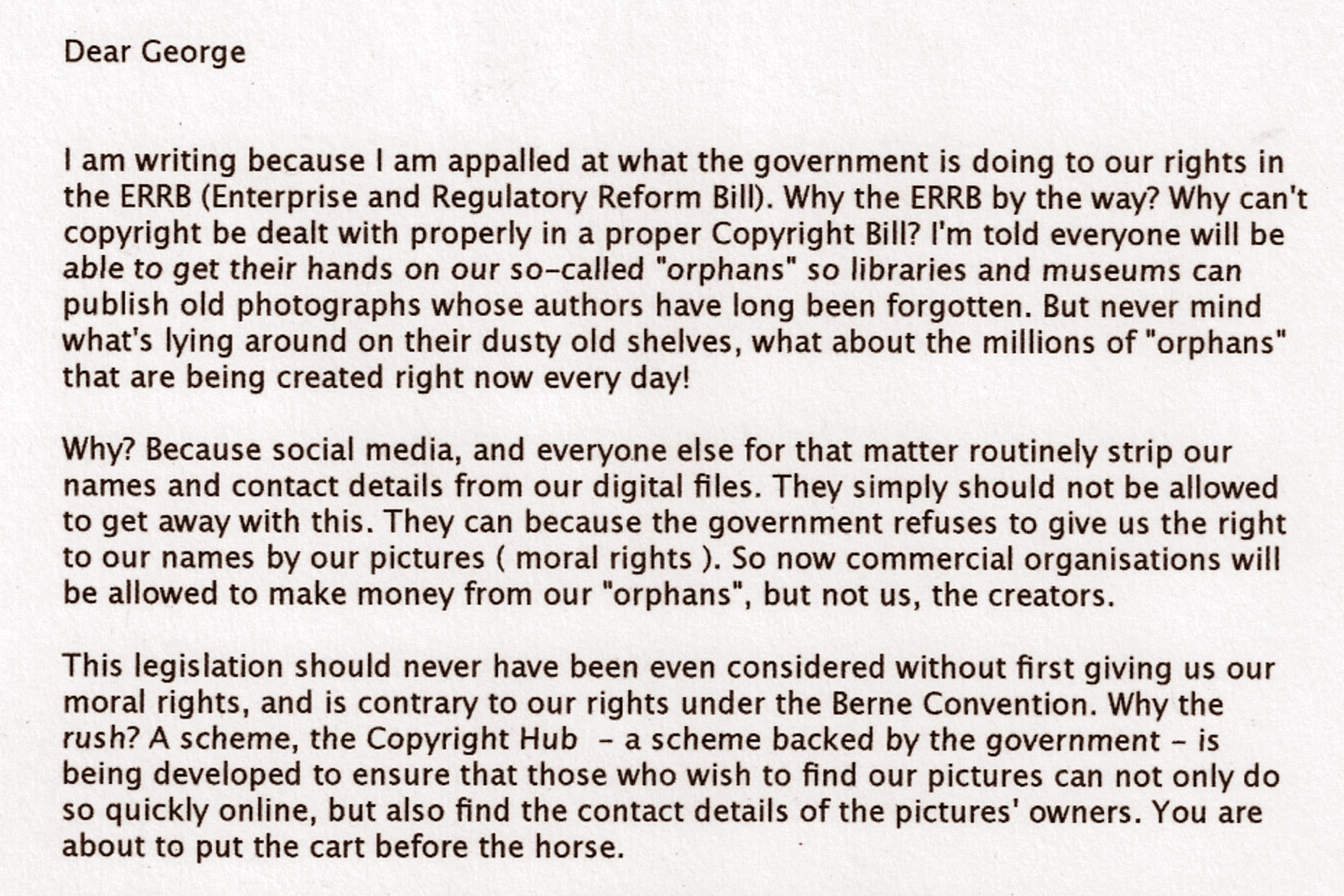
The text of the letter in full:
Dear George
I am writing because I am appalled at what the government is doing to our rights in the ERRB (Enterprise and Regulatory Reform Bill). Why the ERRB by the way? Why can’t copyright be dealt with properly in a proper Copyright Bill? I’m told everyone will be able to get their hands on our so-called “orphans” so libraries and museums can publish old photographs whose authors have long been forgotten. But never mind what’s lying around on dusty old shelves, what about the millions of “orphans” that are being created now every day!
Why? Because social media, and everyone else for that matter routinely strip our names and contact details from our digital files. They simply should not be allowed to get away with this. They can because our government refuses to give us the right to our names by our pictures (Moral rights). So now commercial organisations will be allowed to make money from our “orphans”, but not us, the creators.
This legislation should never have been even considered without first giving us our moral rights, and is contrary to our rights under the Berne Convention. Why the rush? A scheme, the Copyright Hub – a scheme backed by the government – is being developed to ensure that those who wish to find our pictures can not only do so quickly online, but also find the contact details of the pictures’ owners. You are about to put the cart before the horse.
I’m told the real reason for speed is that “releasing” orphans will create growth. We all understand the need for growth. But where’s the evidence? The seemingly impressive financial figures presented originally in the Hargreaves Review have mysteriously had to be revised – down by 97%! Which now apparently amount to no more than 80p per taxpayer per year. Given the damage this legislation will now cause to taxpaying creators, damage no-one has so far taken into account, the effect of this legislation on economic growth will in fact be negative.
It’s not too late to think again!
Best,
David Bailey