What's going on at DACS? Part 2

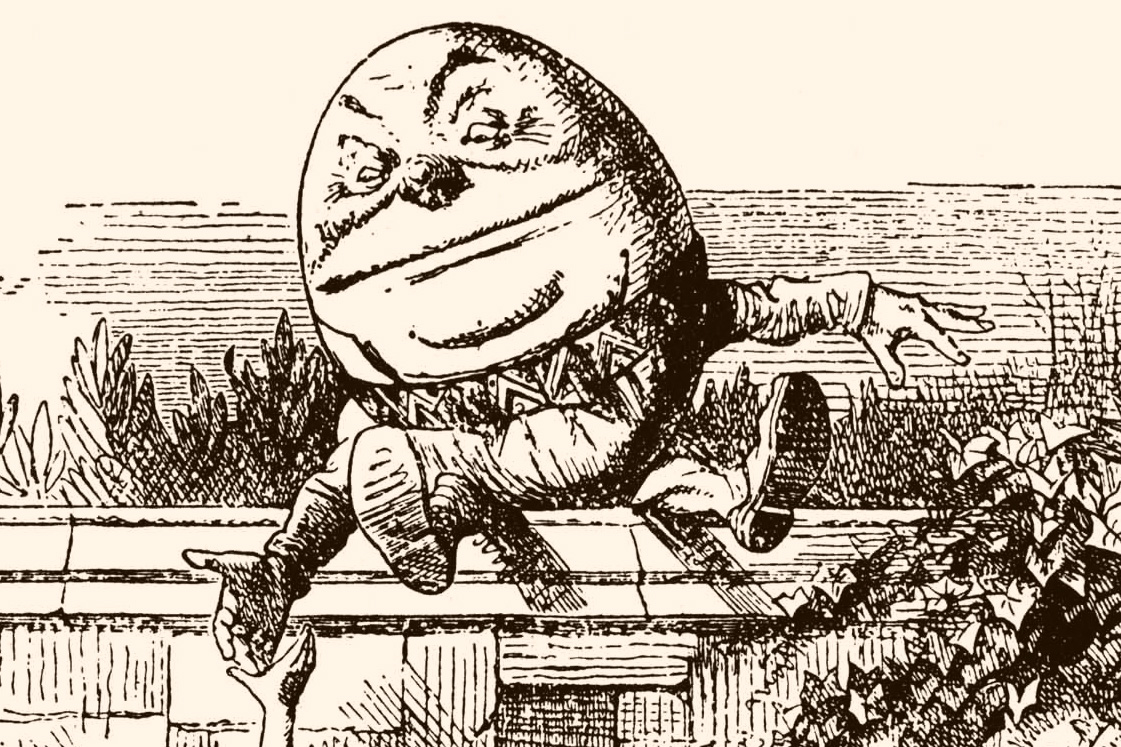
Sir John Tenniel

In this second part of his assessment of what is happening with DACS, Andrew Wiard explains why the current situation is not something that photographers should accept.

“When I use a word,” Humpty Dumpty said, in rather a scornful tone, “it means just what I choose it to mean—neither more nor less.”

Insisting on ALL secondary rights – does it really matter? Is it such a big deal?
Yes it is, but first, what exactly are these secondary rights everyone is talking about? Fact is you will not find a concise legal, or any precise, definition anywhere (or if you find one, please let me know). They can be defined negatively – they are those rights which are not primary. And primary rights are? For want of a better definition, the rights we exercise directly ourselves.This is how DACS describes, not defines, but describes secondary rights: those “ it would be impractical for you to license……. on an individual basis ”. At first sight all sounds plain common sense. Our primary rights  are those we exercise individually and directly (or through our agents) and as for photocopying, well, that’s best left to DACS. That’s secondary. 
But hang on, who decides what rights it is impractical for us to license, and how? What’s secondary and what’s not? Photocopying is pretty obvious, but where is the line drawn and can we trust those who draw it?
Take the strange case of the European “Memorandum of Understanding”.  I first wrote about this for the Stop43 website.  The point here (and I’m afraid you really do have to plough through all that to get it) is that the signatories to this European memorandum were plotting to consign our *primary* rights to collecting societies (you should also read DACS’s reply). The idea behind the MoU was  to republish out-of-print works, for the benefit of humankind of course, if the authors or publishers do not do so themselves. Their rights would have to be taken into account, but then what to do with embedded works, works embedded on the printed page?
Embedded Works? – photographs, to you and me. Ah, the solution is obvious – collecting societies!
Why? Why? If any publisher, any publisher, whoever they are, wishes to produce a new edition of a book containing a photograph which I have already licensed directly once, all I have to do is – do it again. Negotiate a further licence. Directly. Any photographer who supplies books for a living will do this as a matter of course. By any definition, we are not talking secondary rights here. These are primary rights. Our rights. Not secondary rights, the rights which according to DACS, are those it is “impractical for us to license on an individual basis”. But the rights we know perfectly well how to license directly ourselves. No doubt the publishers of out-of-print works will find dealing with us tiresome. All publishers find licensing any works tiresome. But however secondary rights are defined, they are most certainly NOT those rights which publishers find it oh so inconvenient to have to license on an individual basis! And we have no idea what other rights of ours will be considered secondary in future. This is why it is so important that any secondary rights agreement spells out precisely what rights are referred to, and any additional rights to be collectively administered thereafter are specified, negotiated and agreed in advance, and agreed without the threat of money being withheld.
A gang of European collecting societies agreed to this. And our UK rep there? – yes, you guessed it, DACS. Which is why, in their reply referred to above, they are so keen to make out that the memorandum doesn’t say what it means when it says what it says – or rather, as DACS puts it, it is all subject to consultation: “ a collective management organisation for visual works (such as DACS) would be obliged to consult with rightsholders prior to any agreement being reached “. DACS would consult. But that doesn’t explain what on earth they were doing going along with all this in the first place. Consult, over our *primary* rights? And, anyone remember being consulted?
DACS, consult? Really? The way they consulted about this new agreement of theirs? It went like this. First they got a small number of important figures into a room, told them all about the forces of darkness (true) but that none of this could be publicly revealed for fear of (legal?) consequences. Utterly false. It’s all coming out now, but nothing we couldn’t have been told right at the start. These figures were then to go out and tell all photographers, without going into  details, that they must sign up. Which, BAPLA  excepted, they then did. The one thing DACS did not do was consult their contributors. They represent us individually. They were after individual signatures. They should have talked to us, individually.
Instead, a series of inducements, “prizes”, to get people to sign up before the annual deadline. I was offered a prize draw, where I “could win up to £250 in vouchers to spend on art and photography materials” . And if I were to recommend Payback to a friend, “we’ll offer you both the chance to win £150 to spend at on art or photography materials at Jackson’s Art Supplies or Metro Imaging”. Talk about desperation!
Are we adults or kids to be tempted with sweeties?
No mention, of course, in these emails, of the new contributor agreement which had to be signed as the last stage of completing the claims form, or of its significance. Those discussions were only for the chosen few. If you doubt that, look at what happened to the NUJ’s NEC member for photographers Pete Jenkins, who dared to ask them what was really going on. DACS first offered him a meeting before the signature deadline. Then withdrew the offer, refused to meet him, saying they’d be holding a meeting for a wider group after the deadline. After the deal was done and it was all over! And, after the deal? Pete naturally asked to come along but was then told no, they were full up, and they had what they thought was a wide enough range of interested parties already.
Translation – no awkward squad, thank you.
Just before Christmas I received an email from DACS.

“ With the introduction of a new Payback membership, we are now able to formally consult with you on issues concerning your rights, and importantly, safeguard your existing and future royalties.”

What nonsense. They’ve been able to consult us, formally or not, for months. Before, not after, we had to sign. They just didn’t want to.
Let’s be clear what they did. They announced a new agreement. They said they would consult. But not, of course, the individual photographers required to sign. They then stuck to what they said in the first place. The DACS take it or leave it discussion, followed by their take it or leave it agreement.
And what if we did not sign? The payouts last Christmas were for sums collected before last year, that is before this new agreement which has only now come into force, collecting for future payouts in Christmas 2015. DACS was clearly saying, no signature, no payout. You couldn’t complete your claim for this year without it. In other words, they were applying this agreement retrospectively, to enforce compliance. Signing under duress – legal? – well, which one of us had the time, the energy, and most of all the money, to find out?
So, there you have it – consultation, DACS style.
This is serious. DACS say they will consult in future about collecting any other secondary rights. I think I now know what that means. We have given them the power not only to interpret that word as they see fit, but to collect whatever they think falls into that category, and regardless of what we think. They say we can always withdraw our signature at a future date, but so what? Because what we have signed up to now will now in all likelihood give them, under the new ECL regulations, the power to collect the “secondary” rights of all photographers, whether signed up or not. So you can unsign if you like, but you’re going nowhere as DACS will just carry on collecting.
What to do? The law is an expensive but no longer the only way to bring collecting societies to heel. Under the new ECL regulations they have to behave. So the CLA thinks it can collect for pictures but not pay photographers? Time to shop them to the Secretary of State. That’s one way.
There’s another. It will become increasingly practical for us to collect directly. Cue Paul Ellis of Stop 43: “ The solution is obvious – the Copyright Hub, which when implemented will suddenly make a load of ‘secondary’ rights ‘primary’, because it will no longer be impossible for individual photographers to manage them.” The future should indeed lie with the Copyright Hub, see here: https://www.copyrighthub.co.uk/ .
That however is still under development, that is for the future, and today we are already trapped by our signatures. And did we really have a choice?  For there’s no doubt whatsoever that the  vultures are circling. This from DACS earlier this month:

“ In DACS’ view, the CLA is trying to use its market power to reduce the existing 8% share of its revenues that go to visual artists and possibly risk the future of the Payback scheme. DACS has insisted that the existing arrangement should continue until the end of September 2017. This will help manage the transition to any new arrangements and protect our members’ incomes in the interim. To date the CLA has not accepted this.”

The latest is that DACS has now, using the authority we have given them, forced the CLA to accept this – temporary – deal. Only a temporary deal, but a deal none the less.
For this we have paid a heavy price. Let’s be clear. DACS may be on our side. But we have just given a hostage to fortune.

“The question is,” said Alice, “whether you can make words mean so many different things.”

“The question is,” said Humpty Dumpty, “which is to be master—that’s all.”
A Gun To Our Heads – The new DACS Agreement, part 1

Andrew Wiard

In the first of a two-part blog post Andrew Wiard, a member of The BPPA’s Board, asks “What’s going on at DACS?”

Last year we all had to sign a new agreement, and if we didn’t – no annual payout at Christmas. So, why? Short answer, because DACS is at the bottom of a collecting society food chain, and they are all fighting like rats in a sack. Over our pictures, and our money.

Collecting societies – we photographers know that every year we get our DACS money, but not all of us know how or why. Here’s how it works. I’ll make this as simple as I can. In the beginning, way back in 1983, writers (through ALCS, the Authors’ Licensing and Collecting Society Ltd) and  publishers (through the PLS,  Publishers Licensing Society Ltd), established the CLA (Copyright Licensing Agency Ltd), jointly owned by them, for collective blanket licensing on their behalf. Which means authors and other right holders do not issue licences individually or directly, instead the CLA charges clients a one-off fee for a licence to make multiple copies of multiple works, without identifying any of the copyright owners.  So what are we talking about here? Essentially, the photocopying of books and magazines, though there are also other sources of income such as cable retransmission of TV programmes. Which all fall into the category of so-called ‘secondary’ rights. We exercise our ‘primary’ rights directly, collecting societies only stepping in where it is impractical for us to do so. After paying a small amount of money to overseas right holders, CLA then gives the lot to writers and publishers. So what about us then? We photographers said hang on a minute, we are copyright holders too. Eventually the CLA gave us our share through the DACS (the Design and Artists Copyright Society Ltd) payback scheme. Though with only an 8% cut – think that’s because we were late to the party.

Why not newspapers you might ask? Because they set up their own society, the NLA (Newspaper Licensing Agency), paying out to the newspapers, who then pay their freelance contributors any money they think they might owe. Or not, as is usually the case. Anyone remember getting an NLA payout at Christmas? Which is where all the recent fighting started, and that needs a blog all to itself, but briefly, authors were furious at not getting their share of the NLA money. And then a lot of magazine publishers jumped ship from the CLA to join the NLA instead, now re-branded NLA Media Access. After all, why share their (our) CLA money with writers? Or anybody? The ALCS began to fight NLA Media Access, while also fighting – I mean, of course talking – with the remaining CLA publishers over their shares from the CLA. Who have now decided to save money picking on DACS, by tearing up their agreement. That’s right – make the photographers pay! So what exactly are our brothers and sisters in the ALCS – the writers, photographers’ best friends – playing at? They are  joint owners, with the PLS, of the CLA! In the middle of this unholy mess, the CLA chief exec departed.

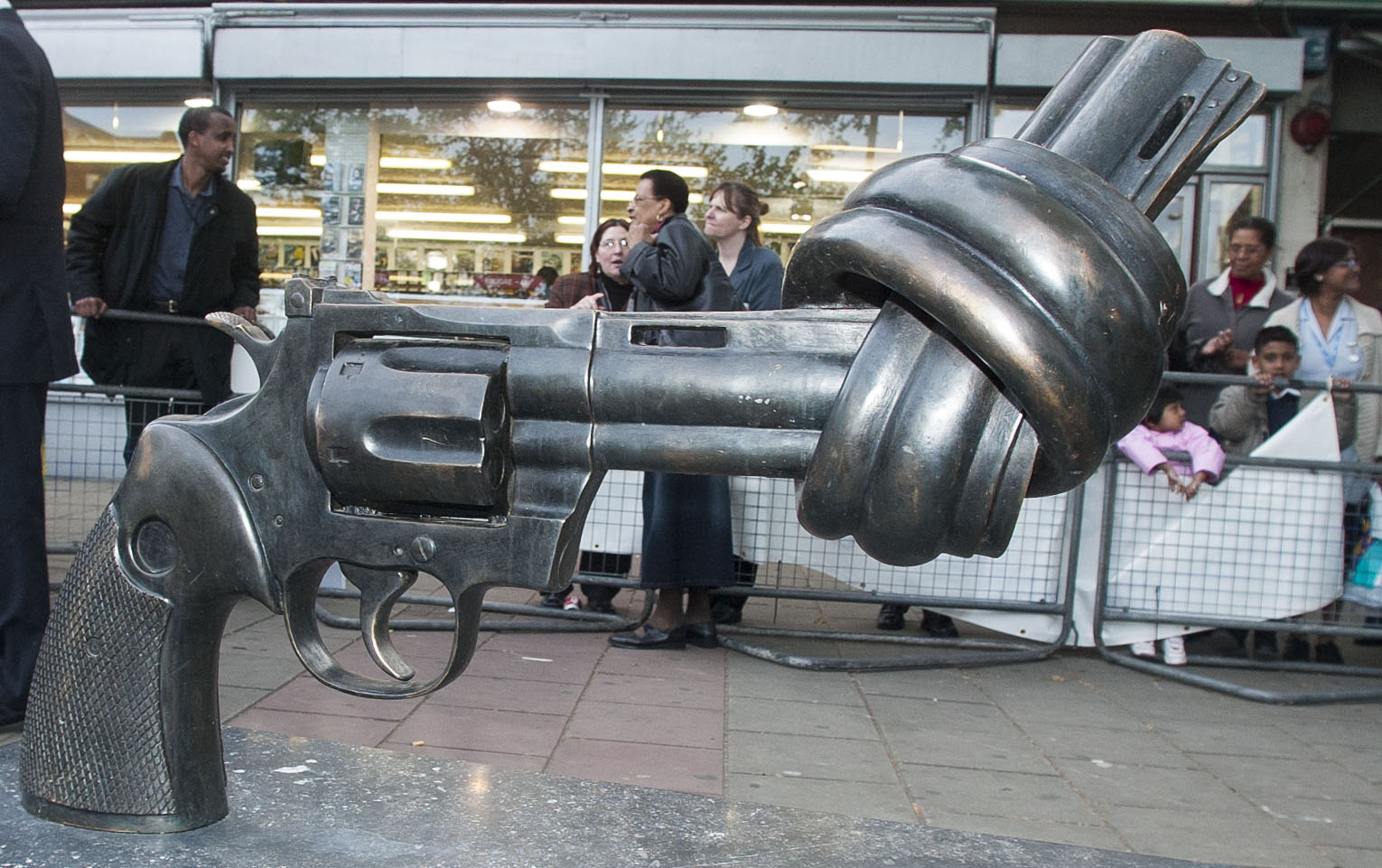
It would seem the CLA put a gun to the head of DACS, and so DACS put a gun to ours. Sign our new agreement here, or get no Christmas money.

Why so? What is this new agreement and how is it supposed to get DACS out of this hole? It requires us to sign over to DACS our secondary rights, exclusively. Actually a new agreement makes a lot of sense. Signing exclusive rights to DACS means they can stand up to the CLA, ALCS, PLS, NLA Media Access or anyone else trying to grab what’s ours, on firm, or at least much firmer, legal ground. It also means DACS can withstand scrutiny under both new EU directives and new UK legislation. Which any other organisation grabbing rights signed exclusively to DACS would – or rather should – be unable to do.

So what’s the problem? Why not just sign? The problem is that DACS is not just seeking the specific rights they already exercise on our behalf today, but ALL our secondary rights tomorrow. The distinction is crucial, see part two of this blog. I’m not the only one to object to this. BAPLA (The British Association of Picture Libraries and Agencies) said, rightly, that the new agreement should be confined to only those secondary rights currently being exploited by DACS, i.e. photocopying/scanning, educational recordings and cable re-transmissions. If DACS is to administer any further rights that should be the subject of future consultation. What could be wrong with that? BAPLA is right. Now we photographers don’t always see eye to eye with BAPLA , and especially when it comes to DACS. Many BAPLA members think they’re the ones who should be taking the DACS money, and a big cut, before handing the rest to us. We think it’s our money ( and it is ) and that we should deal direct with DACS, unless we choose, as some of us do, to go through an agent. Big money at a stake here. But whatever schemes BAPLA may now be planning, with our pictures, we do have common cause when it comes to how and what DACS actually collects. We and our agents must insist on our right to license our photographs directly without a collecting society coming in between – unless, that is, that is totally impractical and absolutely unavoidable.

All we should have been asked to do last year was sign up to what DACS had already collected in previous years. Now what could be simpler than that? But DACS wouldn’t hear of it. They seem to think they don’t have to listen to us – or rather, while they make a great show of listening, they just don’t take any notice. The obvious objections were repeatedly made. They didn’t change a word.

So where does this leave us? As far as I can see the picture now looks like this. The ALCS doesn’t know if it has the legal firepower to fight NLA Media Access. The CLA doesn’t know if it has enough to fight them or their new magazine publishers either. DACS doesn’t know if it has enough to fight the CLA. But there’s one thing DACS knew for sure – we individual photographers did not have the time, energy or the money to take them to court over our payout. So who’s in charge here – us or them? The photographers who took the pictures, or the organisation that claims to represent us?

That money was collected in 2013. In withholding our money to enforce a new agreement for the future they were applying it retrospectively to money that already belonged to us. That was our money. They should have paid it without question and then sat down with all of us to negotiate – repeat, negotiate – the new agreement.

Instead, when the CLA put a gun to the head of DACS, DACS put a gun to ours.

Why all this really does matter? – see Part Two.

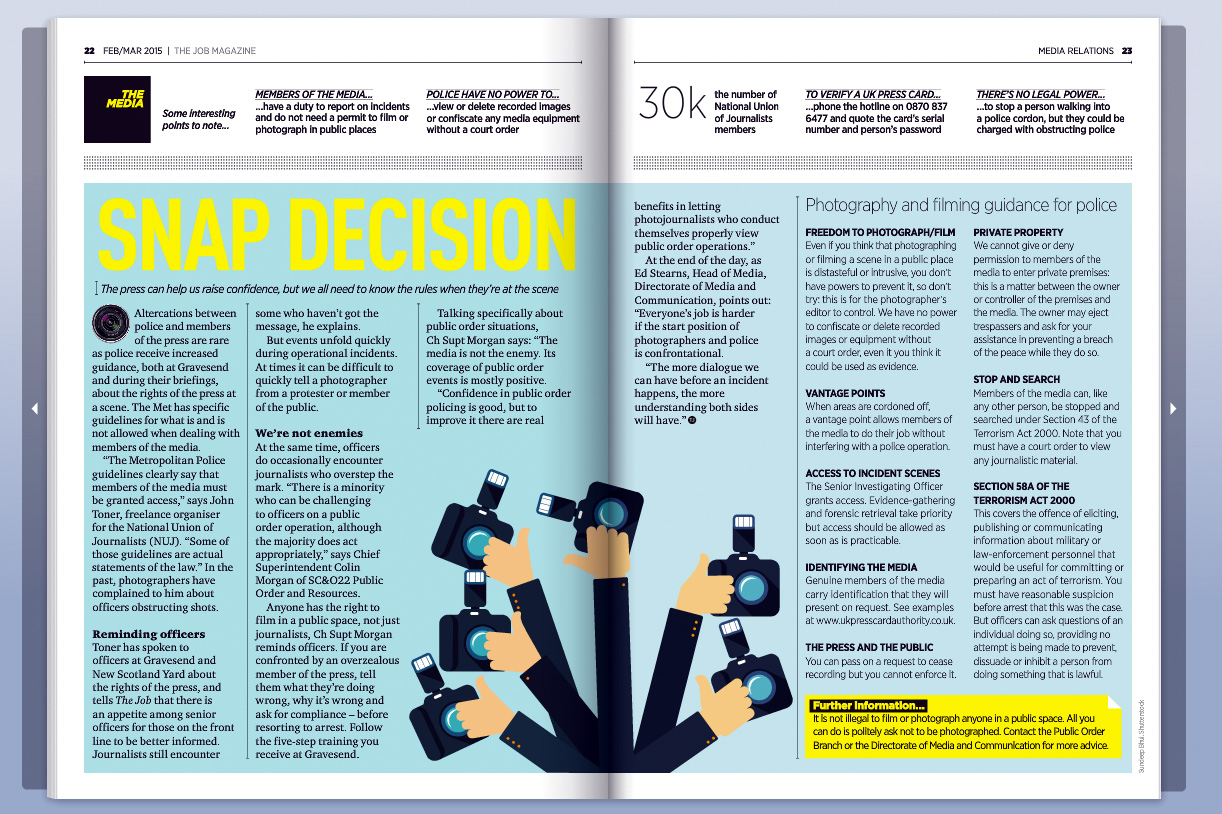
Metropolitan Police Media Guidelines

The Job Magazine

 
There have been a number of versions of the media guidelines from many different police forces over the last dozen years. We have previously made the version developed with The BPPA, the NUJ and the CIoJ available on our website and, following the publication of an article quoting the Met’s guidelines verbatim in their in-house magazine “The Job” we are happy to re-publish them here. Of course these are Metropolotan Police guidelines but they are the same as those agreed by ACPO (the Association of Chief Police Officers) and so they should be equally valid right across the United Kingdom. You can view and download a scanned PDF copy of the pamphlet available to Metropolitan Police Staff from our resources section.

Guidelines for MPS staff on dealing with media reporters, press photographers and television crew

The UK’s nationally recognised Press Card

This is the only UK-wide press card recognised by all broadcast and written news media and the police service. It is only carried by professional news gatherers such as reporters, photographers, TV,cameramen, sound recordists and by direct support staff such as dispatch riders, engineers and drivers. Foreign journalists based in the UK can also carry the card.

The copyright design is owned by the UK Press Card Authority Ltd. Most cards carry one
of the logos shown here but some use the logo of the holder’s publication or broadcaster.

The card is made in the same way as a photo card driving licence and has several security features. There is a UK Press Card Authority hologram next to the word PRESS. Most cards also have a graphic on the reverse showing it is Smart Card enabled. Verify the match by telephoning 0870 8376 477. And check the expiry date – no card is valid for more than two years.

News gatherers do nor have to carry the card. You may need to use a alternative means of identifying the person.

Guidelines for MPS staff on dealing with media reporters, press photographers and television crew

Contact with photographers, reporters and television crews is a regular occurrence for many officers and staff. The media influences our reputation so it’s important to maintain good working relations even in difficult circumstances.

This guide is designed to help you ensure both the police and the media can fulfil their duties without hindering each other.

Freedom to photograph/film

Members of the media have a duty to report on incidents and do not need a permit to film or photograph in public places.

Police have no power or moral responsibility to stop them filming or photographing incidents or police personnel. lt is a matter for journalists and their editors to control what is published or broadcast, not the police. Once images are recorded we have no power to delete them or confiscate any equipment without a court order even if we think they contain damaging or useful evidence.

Creating vantage points

We should actively help the media carry out their responsibilities provided they don’t interfere with ours. When areas are cordoned off following an incident, creating a vantage point where members of the media at the scene can see police activity can help them do their job without interfering with a police operation. Providing a vantage point does not prevent media still reporting from areas accessible to the general public.

Access to incident scenes

The Senior Investigating Officer is in charge of granting members of the media access to incident scenes. In the early stages of investigation evidence gathering and forensic retrieval take priority over media access, but, where appropriate, access should be allowed as is practicable.

Identifying the media

Genuine members of the media will usually carry identification, for instance the UK Press Card, which they will present on request.

Many amateur or “citizen journalists” now carry out a legitimate news gathering role and are unlikely to have special identification. Such news gatherers have the same rights and freedoms as the professional media.

The press and the public

If someone distressed or bereaved asks the police to stop the media recording them, the request can be passed on to the media, but not enforced.

Media on private property

To accompany the police onto private property the media must first obtain permission, which must be recorded, from the owner or controller of the property.

We cannot give or deny permission to members of the media to enter private premises whether they are involved in police operations or not. This is a matter between the owner or controller of the premises and the media.

If the media are trespassing on private property the owner or controller of the premises may eject them and ask for your assistance in preventing a breach of the peace while they do so.

Stop and Search under the Terrorism Act 2000

Officers are encouraged to be vigilant against terrorism but must recognise the balance between effective policing and protecting Londoners and respecting the rights of the media to take photographs.

The power to stop and search someone under Section 44 of the Terrorism Act 2000 no longer exists.

Police officers continue to have the power to stop and search anyone who they reasonably suspect to be a terrorist under Section 43 of the Terrorism Act.

Members of the media can, like any other person, be stopped and searched under Section 43 of the Terrorism Act 2000 if an officer reasonably suspects that they are a terrorist. However, where it is clear that the person being searched is a journalist, officers should exercise caution before viewing images as images acquired or created for the purposes of journalism may constitute journalistic material and should not be viewed without a court order.

Section 58a of the Terrorism Act 2000

Section 58a of the Terrorism Act 2000 covers the offence of eliciting, publishing or communicating information about members of the armed forces, intelligence services or police of a kind likely to be useful to a person committing or preparing an act of terrorism.

It would ordinarily be unlawful to use Section 58a to arrest people photographing police officers in the course of normal policing activities, including protests because there would not normally be grounds for suspecting that the photographs were being taken to provide assistance to a terrorist. An arrest would only be lawful if an arresting officer had a reasonable suspicion that the photographs were being taken in order to provide practical assistance to a person committing or preparing an act of terrorism.

There is however nothing preventing officers asking questions of an individual who appears to be taking photographs of someone who is or has been a member of Her Majesty’s Forces (HMF), Intelligence Services or a constable so long as this is being done for a lawful purpose and is not being done in a way that prevents. dissuades or inhibits the individual from doing something which is not unlawful.

It is a statutory defence for a person to prove that they had a reasonable excuse for eliciting, publishing or communicating the relevant information. Legitimate journalistic activity is likely to constitute such an excuse.

The UK Press Card

All the UK’s professional reporters photographers and broadcast crews are eligible for a UK Press Card which can be used to identify genuine news gatherers.

The photograph and design integrated into the structure of the card. Every card carries the logo of the issuing organisation or the holder’s employer and a UKPCA hologram together with the holder’s name and card serial number.

Each photo card has a unique serial number, and each cardholder has a separate password. To verify the card and its holder phone the hotline quoting the serial number and password: 087O 8376477.

News gatherers do not have to carry the card so you may need to use alternative means to identify them.

The UK Press Card Authority

The UK Press Card Scheme has been in operation since the early 1990s when it was set up to provide a single, national identity card for professional news gatherers. lt is managed by the UK Press Card Authority Limited, UKPCA is supported by all main media organisations, associations and trade unions. A list of designated gatekeepers is available on www.ukpresscardauthority.co.uk or through the Press Bureau at New ScotlandYard.

An open letter to Time Inc UK

 
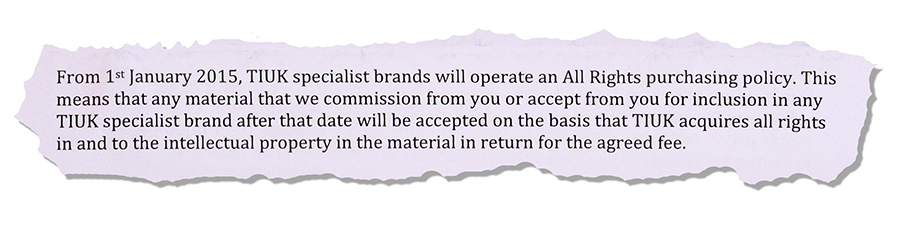
When several photographers started getting letters from Hamish Dawson, Publishing Director  of  Time Inc.(UK) Ltd, Specialist Sport and Leisure with a new rights grab which asked them to agree to sign away all rights in any work that they carried out for the magazines and websites in the group we decided to write to him. Below is that letter and below that is his reply.
We are pretty sure that few people will bother to go down and read what he said in reply but it is worth noting that in the final paragraph he says:
If an individual contributor does not wish to enter into an All Rights agreement, it may be possible for that individual to negotiate a different arrangement, for example, a Qualified Rights agreement. Each case continues to be considered on its own merits, and that decision remains with the senior team on the brand concerned.”
This is a long way from being the response that we would be looking for but it is a course of action that is open to individual photographers to follow if they are offered work by one of the Time Inc UK titles and they don’t want to sign the new contract.

Dear Mr Dawson

What would make a photographer with well over twenty years experience, a mortgage and a family tell one of his key clients to “get lost” – using language that we couldn’t and wouldn’t want to post on a public facing website?

The answer is your new rights-grabbing contract which includes a not-so-subtle line giving them a choice between signing what appears to be a massively unfair deal or losing any and all chance of supplying you ever again. Sadly, you aren’t the first major publisher and buyer of photography to decide that you want to tear up long-standing agreements which saw you buying licenses to use the photographs whilst the copyright remained with the photographer. Sadly, you probably won’t be the last either.

The reason that the old one was a ‘long-lasting agreement’ was because it was fair – the word ‘equitable’ even comes to mind. The fees paid were OK but the ability to re-sell the work after an initial period of exclusivity made the jobs worth doing. Had you, the publisher, substantially increased the fees payable to the photographers to redress this balance then that sense of fairness may have been saved from what most of those photographers feel will be a sad, painful and untimely death.

Receiving these letters just before Christmas has been causing anger, resentment and pain for a large number of photographers who can be excused for assuming that the calculation within the Time Inc UK management must be that enough existing people with no real option to do otherwise will sign and enough struggling photographers who don’t yet work for you will grasp their opportunity to get more work and keep their heads above water.

Make no mistake, this is not a small adjustment to the terms and conditions under which so many photographers supply work to you. This is moving the goalposts, repainting them and renaming them as ‘scoring portals’.

We would like to give you the opportunity to explain why this is being done. We probably know the obvious answers about maximising shareholder returns and the less obvious ones about protecting the brands but what about the relationship that you had with talented, creative and dedicated suppliers?

Does a rights-grab of this magnitude make it worthwhile destroying relationships that have stood the test of time and that have worked well?

Any explanation that you can provide will be shared with photographers because many of our members are struggling with your decision.

Kind regards

Neil Turner

[email protected]

Dear Mr Turner,

Thank you for your e-mail.

As you correctly observe, we are not the first publisher to re-evaluate our rights purchasing position, and a number of our agreements are indeed long-standing.

Unfortunately, while the agreements may not have changed, the markets, media and commercial circumstances in which we all operate have changed quite dramatically over the last few years, and we now operate in quite a different publishing and media landscape to the one which pertained  when many of our existing rights agreements were first set up.

I would first make the point that most of our existing agreements are between IPC Media and the contributor concerned. Since becoming Time Inc. (UK) Ltd., we have viewed it as necessary to bring these agreements up to date. Secondly, many of our agreements do not acknowledge the fact that the company now has significant and rapidly growing, digital publishing platforms and the new agreements reflect this development.

We have also been encouraging our specialist editorial staff to improve the clarity of their commissioning and written communication, and have set out some standards which we expect to be followed, and which we believe are in the interests of both contributors and the brands alike.

Regarding the All Rights agreement that is being sent to Time Inc. (UK) specialist contributors, it has been our practice for a number of years to ask many of our freelance contributors to enter into either an All Rights or Qualified Rights agreement when we purchase content from them. In many instances we’ve asked contributors to sign on-going agreements to cover all the material that they sell to Time Inc. called ‘Core Rights Agreements’. So the agreements that are now being dispatched, while they have been updated and re-worded, are not a new innovation and having a Core Rights Agreement in place ensures that payments can be made to contributors much more speedily than might be the case if individual contracts had to be sent out and agreed on a job-by-job basis.

If an individual contributor does not wish to enter into an All Rights agreement, it may be possible for that individual to negotiate a different arrangement, for example, a Qualified Rights agreement. Each case continues to be considered on its own merits, and that decision remains with the senior team on the brand concerned. Contributors should, however, bear in mind that commercial realities dictate that we will be using the content that we purchase in many different ways, both now and in the future and quite clearly, unless both parties are willing to enter an agreement that suits them both, there is no viable basis on which work can be commissioned or accepted.

I hope that this clarifies our position.

Kind regards

Hamish Dawson
Publishing Director 

Time Inc.(UK) Ltd. Specialist Sport and Leisure

Golf Monthly; Rugby World; World Soccer; The Field; Shooting Times; Sporting Gun; Shooting Gazette; Shootinguk.co.uk; Angler’s Mail; Amateur Gardening

If you know any photographers who are affected by this or who might be affected by it in the future, please share this with them. The terms and conditions under which many of us work are being steadily eroded by publishers who seem to opt for the ‘nuclear’ all-rights option rather than consult with their previously loyal contributors and explore the more equitable route of agreeing licenses that suit the current world of publishing. It is also interesting to note that Time Inc haven’t tried to do this to their US photographers… YET!

Away day… to Poland

As if often the case in the era of multimedia news gathering I was recently despatched to Poland on a whirlwind visit to shoot stills and video. A British armoured Battlegroup have been taking part in war games with the Polish military entitled “Black Eagle” for several weeks and the press had been invited along to coincide with a visit by the Chief of the General Staff – General Nick Carter .
We had to be at the army base in Poland bright and early on Friday morning so our only choice was to fly late Thursday night to Berlin and then drive for the border – luckily only a two and a half hour drive. Our hotel for the night was literally a truck stop motel, with a bit of a Swiss chalet style thing going on, but being a 10 minute drive from our rendezvous point the following morning it was bearable .
Now, I have this thing as many of you probably do where I conjure up in my head a “ best case scenario” of what to expect on a job and then set myself up for disappointment . In this case I envisaged myself in a trench with a screaming corporal throwing smoke grenades as the tanks roared forward all shot on a 24mm …….
As if….. After being transported to the range with a host of other media from the likes of ITN, The Times (sans photographer) the BBC and a likeable but complete anorak from Combat and Survival mag we found ourselves on a Soviet era style viewing platform from where we were expected to shoot all our images. No chance of using a 24mm here !
The again they were going to be firing live rounds so probably was best to be have some distance between us. Luckily due to some advice from a former Telegraph colleague who now picture edits for the Army I had begrudgingly brought a 300 and an extender with me without which I would have been in deep trouble, but was still utterly under-lensed for the live fire part of the exercise .
3 (UK )Division on the largest joint military exercise since 2008 in Zagan Poland with the Polish 11 Armoured Cavalry Division.© Heathcliff O'Malley
Armoured vehicles including Leopard II tanks from the Polish 11 Armoured Cavalry Division 3 (UK )Division on the largest joint military exercise since 2008 in Zagan Poland with the Polish 11 Armoured Cavalry Division. ©Heathcliff O'Malley
Chief of the General Staff - General Sir Nicholas Carter . The 3 (UK )Division on the largest joint military exercise since 2008 in Zagan Poland with the Polish 11 Armoured Cavalry Division
I recently bought a Canon C100 video camera, which takes all my EF lenses, which has revolutionised video for me . I now no longer have to fanny about with a 5D taking bits on and off depending on whether I’m shooting stills or video with it’s built in ND filters and XLR inputs . I now have a dedicated video camera which can use all the lenses I have collected over the years . Mind you this doesn’t solve the issue of when to shoot stills and when to shoot video on an assignment where there are no second chances .
Once the demonstration started there was nothing I could do but go with the flow and let my instincts take over. My c100 was mounted on a tripod and as the Challenger II tanks burst out of the tree line I panned with them and when I felt I had enough moved to stills leaving the camera rolling . I continued in this fashion alternating between camera until the tanks were probably a 750m off in the distance shrouded by a cloud of smoke which only the muzzle flashes of their powerful guns could penetrate. At one point I even mounted the 300 2.8 on the c100 for a few long shots and the 1.5 crop factor really helped.
Afterwards we got to have a short walk about where I bumped into an old school friend I hadn’t seen in 30 yrs who is now a Brigadier and shot some short lens stuff of soldiers and officers that made a huge difference. Finally there was an interview with the general and piece to camera with the reporter Ben, whom I had worked with a lot over the years and has now gained the confidence needed to stand in front of a camera, a skill which is not to be underestimated.
After a quick edit, caption and send of the stills we jumped back into the hire car for the drive back to Berlin with only around five hours before our flight was due to depart forcing me to edit whilst Ben drove down the dual carriageway westwards. The stars we clearly in alignment that day as miraculously my 4g mifi worked flawlessly (never usually does when it really matters!) and was able to file the video before going through to departures and the luxury that awaited with our Easyjet flight back to Gatwick .
See the video here https://vimeo.com/113108829

New from the UKPCA – Passport and Chips

All change at the UKPCA – the UK Press Card Authority, where the BPPA is one of the card issuing gatekeepers. At today’s meeting they voted nemo contra for two fundamental reforms.
The meeting faced two problems. First, Custom Card, who administer the card on behalf of the gatekeepers, had detected two duplicate applications for the card from one individual through two different gatekeepers using subtly different details! The database relies on these details and the fraudulent application was only spotted because both applications came in on the same day with the same photograph. Fraudulent information undermines the integrity and security of the entire system. Clearly the case for independent verification of personal information is overwhelming.
Secondly the UKPCA had been approached by Downing Street police, asking  in the nicest possible way what we could do about security generally, and saying they got on well with the regular photographers, but they’d had complaints from them about people getting in with Demotix cards,  some of whom did not appear to be even taking any pictures!
Demotix cards – the ones that look surprisingly, alarmingly, you might even suspect deliberately, just like ours.
Custom Cards wanted to activate the card chips, which all UKPCA cards now carry, in full – all data, not just pin numbers (the phone line verification for which is not 24 hours). And they now have an app which would allow police to check card holders instantly and speedily. That would take care of any confusion over those Demotix cards looking so  much like ours, because they just don’t have one. And avoid what one photographer recently went through in Downing Street – 45 minutes while police checked him out.
So why on earth hasn’t this been done before? The chips are all there, all ready, we all pay for them….answer, because the NPA and NS simply refused to cooperate. That’s now history. The vote’s been taken. All gatekeepers must now accept fully working chips as a condition of remaining gatekeepers. Custom Card will now switch them on, and distribute the app.
Back to personal information – the other major change. From today, for verification purposes, all applications for the press card must be supported with the number, and a scan, of either passport or driving licence. Speaking for myself, I cannot imagine why anyone thinks this such a big deal – every year I submit both my passport and driving licence numbers three times, to get into the major party conferences. And have always thought it absurd that I have to meet a higher standard of security vetting to get into those than I do to stand all day outside No.10.
These two long overdue, vital changes will improve both the security and the authority of the – our – press card. And make card checks easier , faster, and painless for all concerned. Job done.
 

Mentoring young photographers

Phil Clarke-Hill

It goes without saying that the business is now unrecognisable from the one that I entered in the early 1990s. Then, the structure was relatively linear and there was a clear defining path to an editorial career. Now, every photographer has to be a brand and use social media to shout their wares and tout their abilities. It isn’t even clear what editorial or documentary photography actually is anymore.

I’ve talked before about a ‘bleed’ from the art world and as previous postings on this site seem to indicate, a good deal of photographic education now wraps itself in talk of ‘practice’ and pseudo academic language.

As an editorial photographer and one that works in a documentary tradition, I’m actually delighted that new ways of seeing are being utilised but I’ve always tried to make work that is simple and engaging. I firmly believe that if you’re photographing people in (often) difficult situations you have a duty to be clear and straightforward and that your work should be similar. Your work should be about the subject and not about you.

It’s hardly surprising then that there’s a good deal of confusion about how to progress within the business – or more crucially how to make pictures that won’t fade with current fashions but have a longevity that speaks to an audience with simplicity and crucially, I think, a beauty.

In the past, when I was stuck visually or with an issue of editing, I could ask older, wiser members of my agency for help and advice. That old agency structure has now by and large fallen (in some ways a positive step) and it often leaves people working in a vacuum.

Photography – documentary photography, photojournalism – whatever you call it, is analogous to its written cousin. It is fundamentally a craft that has elements that are worth learning. I’ve always thought that if you are trying to communicate with an audience by showing them the world (perhaps with a view to changing/challenging their opinions) your work must be clear and simple. That isn’t to say dull, but it must be engaging and understandable. There are so many images now and so many photographers producing them. If everyone’s a photographer then you have to make sure that even if your Tweeted voice isn’t the loudest, the work that you produce is the absolute best it can be.

Over the last decade I’ve had dozens and dozens of young (and some not so young) photographers writing to me to ask if they can assist me or just get feedback on their work. I certainly don’t have all the answers, but if someone sends me a half decent email I‘ve always responded and if I’m in the UK, often arranged to meet.

Phil Clarke-Hill emailed me several years ago to ask my honest opinion of his images. We met up several times and it was clear that although he had talent and a strong desire to shoot, he wasn’t as focussed as he could be and his way of shooting was too loose. Some of his frames had a picture in them desperately trying to get out.

I had him shoot some exercises, I lent him an old lens. I set him a project to work on. I made him change where he stood. I made him look up some photographers that I really admired and crucially explained why I thought their images worked and still work. Moreover, I made him aware of authors that wrote beautiful reportage. I’m convinced that there is a symbiosis within all journalism and in the best practitioners there is an erudition, a refinement, a clear, simple way of communicating a story to an audience that transcends the medium.

Phil listened and really engaged. He started to make pictures that were clearer and that said what he wanted them to say – images that could be read visually. Two years later, he’s in a very different place. He’s shooting assignments for good magazines and specialising in South America – especially Brazil. He regularly emails and sends me stuff and asks advice about the things that don’t often get discussed – travel, visas, logistics, pitching – essentially, being a professional. He’s just about to make a book and has an exhibition soon. It’s surprised me how much I’ve enjoyed the process myself – seeing someone benefit from my experiences and (many) mistakes.

Someone else that I’ve worked with over the last couple of years is the young Bangladeshi photographer Farzana Hossen. I taught a workshop in Chittagong four years ago for the Pathshala Institute for a group of local and visiting Norwegian young photojournalists.

Farzana, it was clear, was an exceptional photographer with an inherent and classical visual sense and she was full of questions – not about ‘how’ but ‘why’. The series that she was working on, about her own family, was both mature and subtle. Her next work about violence against women in Cairo was more straightforward visually but much more complicated to shoot. We spoke over email and ‘phone about the logistics and dangers of the work (during the 2013 demonstrations) and I did my best to advise on fixers and contacts for her work. Later that year when she came to London I helped edit her project on acid attack survivors that won her the Ian Parry Award.

Currently, I’m working with a photographer in New Delhi (where I’m still partly based) and another in the UK. What’s really interesting for me, is that I feel the process has invigorated my own work. I have a new book out next year and I can honestly say that some of that work was influenced as much by working with (and learning from) several younger photographers. It may be clichéd but it’s true that it’s been enormously gratifying to be able to help someone and pass on what (limited) knowledge I have.

My mentoring isn’t intended to be a competitor to a University course – many of which I’ve guest lectured at – I see it as guidance for people who are actually trying to work in an industry that is both confusing and constantly moving.

Stuart Freedman is a Freelance Photojournalist and Mentor who points out that his degree is in Politics rather than photography. His website is https://www.stuartfreedman.com/mentoring/

 Phil Clarke-Hill

British Photographic Council concerns over consequences of new copyright law

This is a re-posting from the British Photographic Council’s website. The BPPA is a member of the BPC and members of The BPPA’s Board have been deeply involved in the process so far.
Government adopts “friendless, unnecessary, poorly explained and fraught with risk” new copyright legislation, against united opposition from the photographic sector.
In all of the publicity over the impending introduction of new ‘Orphan Works’ legislation, some of the finer points of proposed changes to copyright legislation have been overshadowed, including Exceptions to Copyright for Private Copying and Quotation and Parody.
These two exceptions went before the House of Lords for debate at the end of July 2014, with none of the concerns having been regarded or addressed by Government Ministers, and despite questions from the Joint Committee on Statutory Instruments concerning their legality under EU legislation.
These changes have now been approved, threatening seriously to impact photographers many of whom may not even have been aware of these proposals. The government has made these changes through Statutory Instruments, or secondary legislation, rather than being subject to the full scrutiny of parliamentary debate, which accompanies proposed changes to primary legislation.
The most important relate to Copyright Exceptions, which are those recognised exceptions to UK copyright law that allow use of copyright material for education, archiving and similar purposes without breaching copyright. These currently work well and are precisely worded to ensure no ambiguity.
Members of the British Photographic Council have been expressing concern over proposed changes to these exceptions since meeting with the then Minister for IP (Intellectual Property), Viscount Younger of Leckie, over a year ago, and a Joint Position Paper followed. Among the concerns were the proposed changes to the exceptions for Private Copying and for Quotation and Parody. Of particular concern was the ambiguity of the wording and the impracticality relating to how photographs could be ‘quoted’ and the separation of quotation from the previous sensible restriction to criticism and review, leaving its purposes vague and apparently limitless.
The ambiguity in the exceptions will require legal definitions that will be left to the UK courts to decide. There will be a financial impact for photographers both in loss of licensing revenue and in the cost of legal claims and damage to the reputation of photographers, particularly in the area of journalism and current affairs. Further restrictions are needed in the use for Parody & Quotation, to limit the impact of derogatory use. The impact assessments have been clearly done in a ‘one size fits all’ manner, with no consideration to the business models of the photographic sector.
Also approved was the exception for Private Copying with no compensation for rights holders, unlike in Europe where there is a compensatory levy.
We ask the Government where’s the evidence that supports these changes, who did they look to, and are they really striking the right balance for individual creators such as photographers?
The BPC supports concerns over the legality of these draft regulations that have been raised by various bodies such as the British Copyright Council, and our members including BAPLA, NUJ, AOP, BIPP, EPUK, BPPA and Redeye. We believe the Government would be acting ultra-vires if these regulations are implemented as drafted.
The BPC wrote to Lord Stevenson of Balmacara, Lord Clement Jones and Baroness Buscombe outlining these concerns, asking that they reject these proposals so that they can be subjected to the full scrutiny of Parliament via primary legislation.
During the debate Lord Berkeley of Knighton said: “Many people working in the creative industries live on fairly modest means. Their royalties need to be protected—without them, they will find it very hard to survive.”
Lord Scott of Foscote added: “The importance of this is plain. There are a number of individuals who create copyright works on which they rely for their livelihood. They are entitled at the moment to the protection of the law of copyright so that the work they have brought into existence is not taken advantage of by others, without reward for them. The regulations now before the House will have a very serious effect indeed on people of that sort.”
Baroness Morris of Yardley said: “I agree with everyone else who has spoken. I have real doubts about what they will mean for the creative industries.”
Lord Grade commented: “the Government are demonstrating a complete ignorance of the economics of investment in the creative industries. Today’s Motion is yet another example. It is time they tore up the Hargreaves report and listened to the people who make the investments.”
Lord Clement-Jones said: “I am afraid the statutory instruments will pass today, but they are fairly friendless and fraught with the risk of legal challenge. They are badly worded and unnecessary, and they are poorly explained, and the consumer will remain confused.”
Lord Stevenson of Balmacara concluded by saying: “The feeling in the industry is that the battle over these regulations is over and that those affected have been consulted to death but not listened to and, as a result, are simply exhausted. That, more than anything, suggests that the Government have got this completely wrong from beginning to end— although, in fact, I do not think that we have heard the last of these proposals.”
The House of Lords approved the exceptions with scepticism from our supporters. We want to see the Government start the process of a proper impact assessment straight away, working with photographers and their representatives to review the impact it will have over the next year, and ask both Parliamentary Houses to table the review at the earliest in 2015. Surely this approach is the purpose of legislation and the practice of good policy.
The British Photographic Council (BPC) represents over 20,000 photographers via 14 member organisations including trade associations, unions, institutes and networks. They are: Association of Photographers; British Institute of Professional Photography; British Press Photographers’ Association; British Society of Underwater Photographers; Bureau of Freelance Photographers; Chartered Institute of Journalists; Editorial Photographers UK & Ireland; Master Photographers Association; National Association of Press Agencies; National Union of Journalists; Outdoor Writers and Photographers Guild; Pro-Imaging; the Royal Photographic Society and Redeye, the Photography Network.
For further information please contact:
Isabelle Doran (BAPLA) on 020 7025 2256
Simon Chapman (NUJ) on 07889 747916
Andrew Wiard (BPPA) on 07973 219201
Denise Swanson (BIPP) on 07973 373657